

The first time I wore the 3M Peltor Sport Tactical 500 at a track, I was standing at the fence for hot laps with my nephew Deacon, who was 13 that summer and more interested in pit lane radio chatter than the actual racing. Even with the volume dialed down low, I could still hear him ask what a lap time meant, and that's really the whole pitch behind an electronic earmuff at a race. You're not trying to go deaf to the world around you, you're trying to turn the engine roar down and the conversation up, and do it for eight or nine hours without your ears ringing on the drive home.
Walker's Razor Slim earmuffs get recommended in the same breath as the Peltor constantly, and for good reason. It's roughly a third of today's price and noticeably slimmer on the head. But after a full season of short-track Saturdays and one long big-track weekend wearing both, they are not interchangeable. One is built to do more, and costs more for it. The other is built to do the one thing most people actually need, and does it for a lot less money. Here's exactly where each one earns its spot in a bag.
| 3M Peltor Sport Tactical 500 | Walker's Razor Slim | |
|---|---|---|
| Price (today's price) | Mid-range price point | Affordable at today's price |
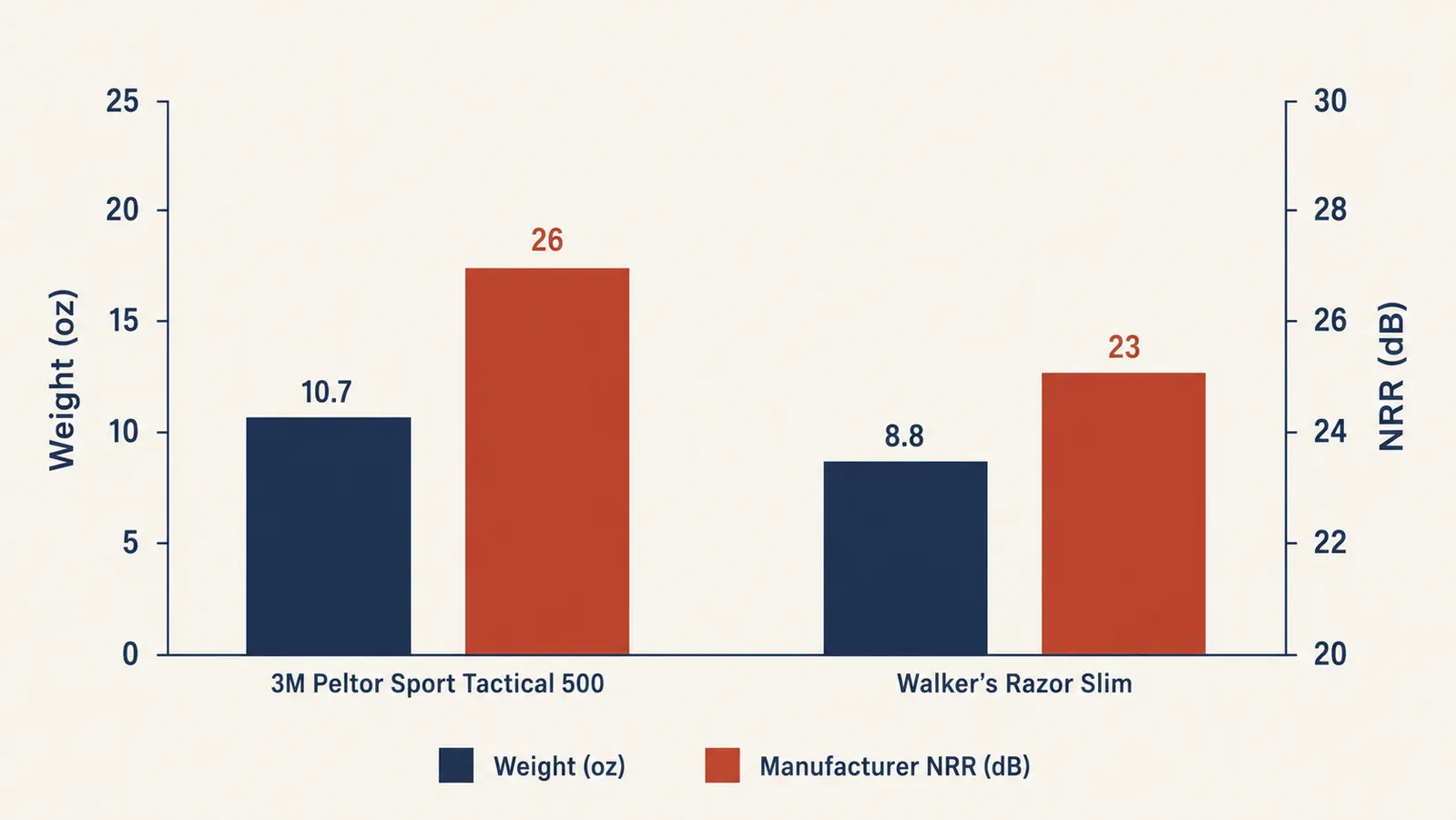
| Weight | About 15 oz, standard tactical heft | About 7 oz, one of the lightest electronic muffs available |
| Ear Cup Profile | Standard cup depth, sits a bit taller off the head | Ultra-slim cup, sits close and low to the head |
| Manufacturer NRR | 25 dB NRR | 23 dB NRR |
| Connectivity | Bluetooth 4.1 streaming plus a companion app for EQ and mode presets | No Bluetooth, single volume and mode dial |
| Battery Life | Around 350 hours on 2 AA batteries, rechargeable pack sold separately | Around 300+ hours on 2 AAA batteries, no rechargeable option |
| Amplification | Adjustable directional mics with multiple volume settings, stronger pickup on quieter voices | Directional mics with basic volume control, flatter overall sound |
Where the 3M Peltor Sport Tactical 500 Wins
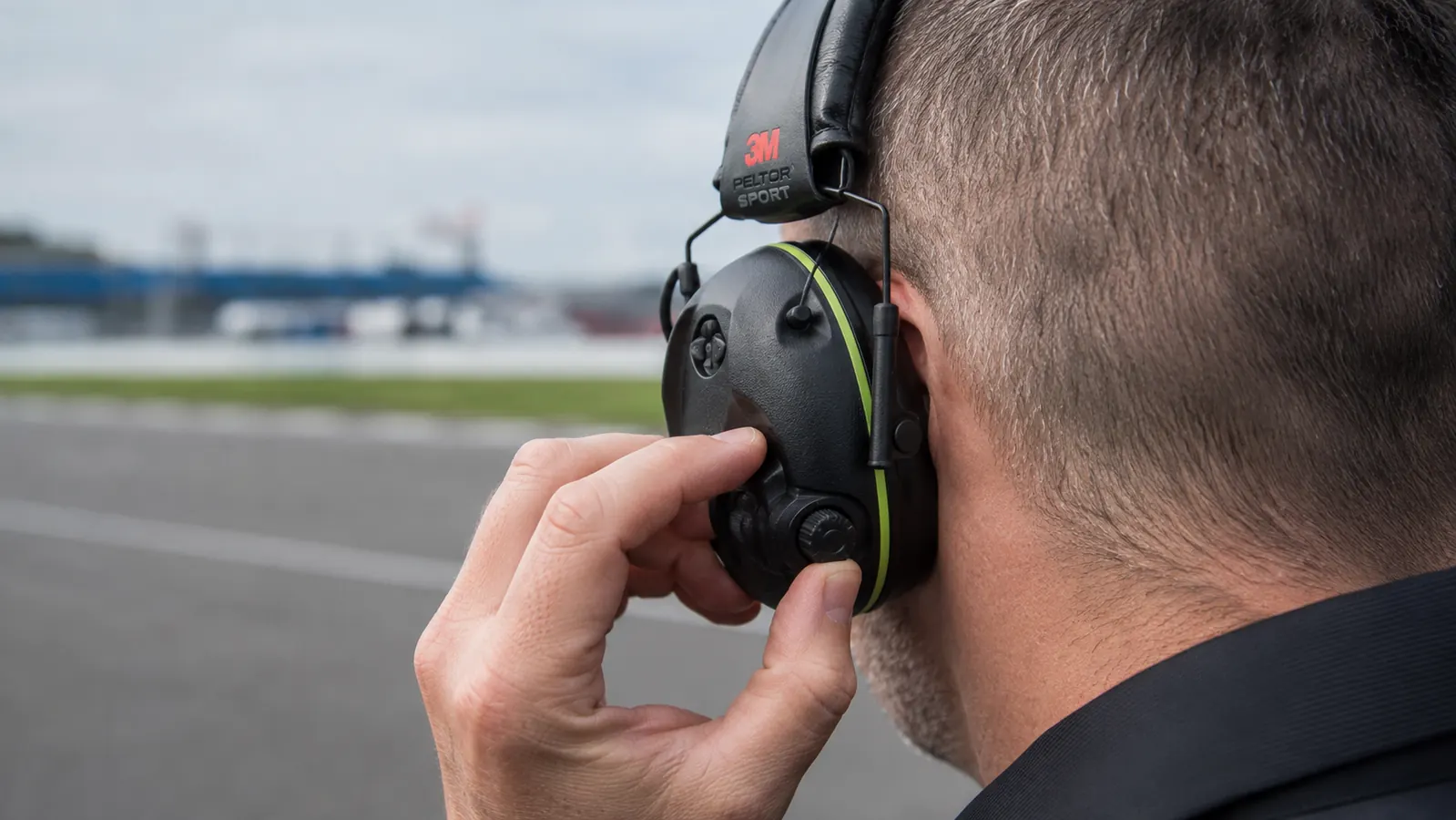
The Bluetooth is the real difference-maker. Once it's paired to my phone, I can stream a race scanner app or a podcast straight into the muffs and still hear Deacon, or my son Beckett, tap me on the shoulder without pulling anything off my head. The Razor Slim I tested has no Bluetooth at all, just a volume dial and a mode button, so if you want scanner audio or music piped in, you're either holding a separate speaker up to one ear or missing half of what's happening around you.
The manufacturer-rated NRR is 25 dB on the Peltor versus 23 dB on the Razor Slim, and while 2 dB doesn't sound like much on a spec sheet, it was noticeable at a short track where the cars run closer to the fence and the engine note is sharper. On loud straightaway passes, the Peltor took more of the edge off before the electronics even kicked in to bring the quieter stuff, like a spotter's voice, back up.
Battery life is longer too, close to 350 hours on two AA batteries, and 3M sells a rechargeable pack separately if you'd rather not keep restocking AAs out of a truck console. The Razor Slim runs on two AAAs with no rechargeable option, which feels like a minor thing right up until you're the one digging through a glovebox for batteries between qualifying and the main event.
Where Walker's Razor Slim Wins
Price isn't close. The Razor Slim runs well under half of today's price on the Peltor, and for a parent buying two or three pairs so the whole family can stand at the fence together, that gap adds up fast. I bought Deacon his own pair of Razor Slims instead of a second Peltor specifically because I couldn't justify the price difference for a 13-year-old who'd probably leave them in a truck bed by August anyway.
The slim profile is real. At around 7 ounces with a noticeably shallower ear cup, the Razor Slim sits closer to the head and doesn't fight with sunglasses arms or a ball cap the way a bulkier tactical earmuff can. On a hot day at the track, less bulk on your head matters more than it sounds like it should, especially by the back half of a triple-header.
It's also just simpler to hand to someone. If a buddy at the fence wants to try a pair on for a few laps, there's nothing to explain. Turn the dial up, put them on, done. The Peltor has a learning curve with the app and the pairing that most people figure out in five minutes, but that's still five minutes more than the Razor Slim asks of anyone.
Fit, Comfort, and a Full Day at the Track
I wore the Peltor through a full big-track weekend, gates open to checkered flag, and the padding held up fine, but I noticed the extra weight by the third hour, especially with sunglasses on underneath. The Razor Slim disappeared in a way the Peltor never quite did, which is the tradeoff you're making for the Bluetooth hardware and the bigger battery compartment sitting on each ear cup.
Neither one is uncomfortable, to be clear. This is closer to which annoyance you notice less than one being good and one being bad. If you wear a cap to every race, the low-profile fit of the Razor Slim will bother you less by lap 200. If you don't wear a cap and don't mind the extra ounces, the Peltor's padding is plenty comfortable on its own, and the clamping force never gave me a headache the way some cheaper muffs have.
Testing Conditions: Two Tracks, One Season
Most of my testing split between two very different environments, and that matters more than a spec sheet comparison lets on. A local dirt short track on a Friday night is loud in short, sharp bursts, engines revving at the line and then trailing off into the corners. A big-track weekend is a different animal entirely, a steady wall of sound for hours with no real quiet stretch to give your ears a break. The Peltor handled the second kind of grind noticeably better, and that's really where the extra investment shows up.
Neither pair claims to be anything beyond what's printed on the box, and I'm not going to pretend either one turns a loud track into a library. What they both do is take the edge off consistently enough that I don't leave a race with that dull ringing I used to get standing at the fence bare-eared, back before Deacon ever showed interest in any of this.
Noise Reduction Numbers vs Real-World Feel
There's a gap between the printed NRR number and how a pair actually feels three hours into a race, and that gap is where a lot of buyers get surprised. A 25 versus 23 dB spec looks like almost nothing on a box, but noise reduction doesn't scale in a straight line, since it's measured on a logarithmic scale, so a couple of decibels at the loud end of a race track registers as more than the raw number suggests. I noticed it most on long green-flag runs, less on short caution laps where the difference barely mattered either way.
What the spec sheet won't tell you is how much of that rating depends on getting a proper seal. Sunglasses, a thick beanie in cooler weather, even hair pushed the wrong way under the cup will eat into the real-world NRR on either pair faster than switching brands ever will. I got a more consistent seal on the Peltor simply because the cup is deeper and more forgiving of what's underneath it, while the Razor Slim's slim design, the same thing that makes it comfortable, gave up a little bit of seal quality once sunglasses were in the mix.
Durability After a Full Season
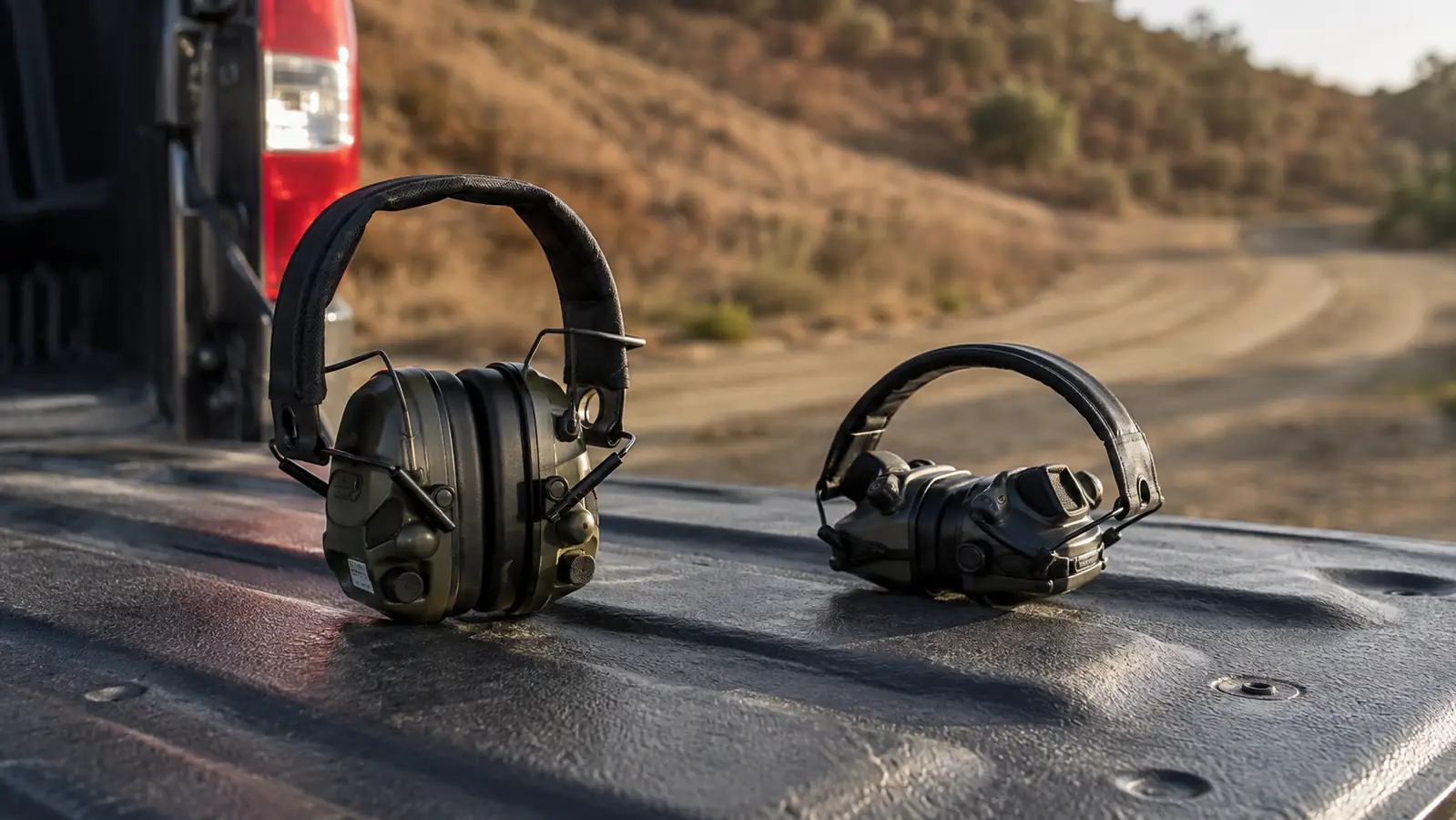
After a full season, both pairs are still working the way they did on day one, which says as much about how gently a lawn chair and a cupholder treat gear as it does about either product. The Peltor's hinges and headband held their tension, and the ear cup foam hasn't flattened out despite a lot of sweaty August nights. The Razor Slim's lighter build had me a little worried early on, but the housing hasn't cracked or loosened, even after living in a truck door pocket for most of the summer.
The one wear difference I did notice was the volume dial. On the Peltor, it's recessed enough that it rarely gets bumped by accident. On the Razor Slim, the dial sits a little more exposed, and I've had it get nudged reaching for something in a cooler more than once, which meant a startled volume jump mid-race instead of a smooth adjustment.
A 25 versus 23 dB spec looks like almost nothing on a box, but noise reduction doesn't scale in a straight line.
Bluetooth, Pit Radio, and Real-World Use
The Peltor's app lets you set independent volume for ambient amplification versus streamed audio, which matters more than it sounds like on paper. I keep the ambient amplification low so engine noise doesn't blast through the mics, but keep streamed scanner audio a notch higher so I can actually follow what a spotter is telling a driver. The Razor Slim has one dial doing double duty for both, so you're compromising on each at the same time instead of tuning them separately.
If you don't care about streaming anything and just want the roar turned down and nearby voices turned up, none of that matters to you. That covers most people standing at any short track on a Saturday night, and it's exactly why the Razor Slim sells as well as it does. Buying features you'll never touch isn't a win just because they exist.
One more thing worth saying plainly: don't let the Bluetooth feature talk you into the Peltor if you know yourself well enough to know you'll never actually pair it to anything. I've met plenty of guys at the fence who bought the fancier pair, downloaded the app once, and never opened it again. If that's you, save the money and get the Razor Slim instead, because a feature sitting unused in a settings menu isn't worth the price gap on its own.
The Two Decibels That Actually Matter at a Race
If you're trackside for a full weekend and want the streaming, the app control, and the extra NRR, the 3M Peltor Sport Tactical 500 is the one that holds up over a long day.
Amazon Check Today's Price on Amazon →Who Should Buy Which
If you get to more than a handful of races a year, want to stream a scanner app or podcast, or you're trackside long enough that battery life and that extra 2 dB of NRR actually matter, the 3M Peltor Sport Tactical 500 is worth the jump in price. It's the pair I reach for on any weekend I already know is going to be a long one, gates open to the checkered flag.
If you're outfitting a family, buying a backup pair, or you only make it to a couple of races a season and just want the noise turned down without spending premium money to do it, Walker's Razor Slim gets you most of the way there for a fraction of the cost. That's exactly why it's in Deacon's bag instead of a second Peltor.
There's no wrong answer here, just a different question each one is answering. The Peltor is for someone who wants a hearing protection setup that also handles communication and streaming. The Razor Slim is for someone who wants the noise handled, full stop, and doesn't want to pay extra for anything beyond that.
Ready for a Full Season of Race Days Without the Ringing Ears?
See the current price, real owner ratings, and full spec sheet for the 3M Peltor Sport Tactical 500 before your next weekend at the track.
Amazon Check Today's Price on Amazon →