
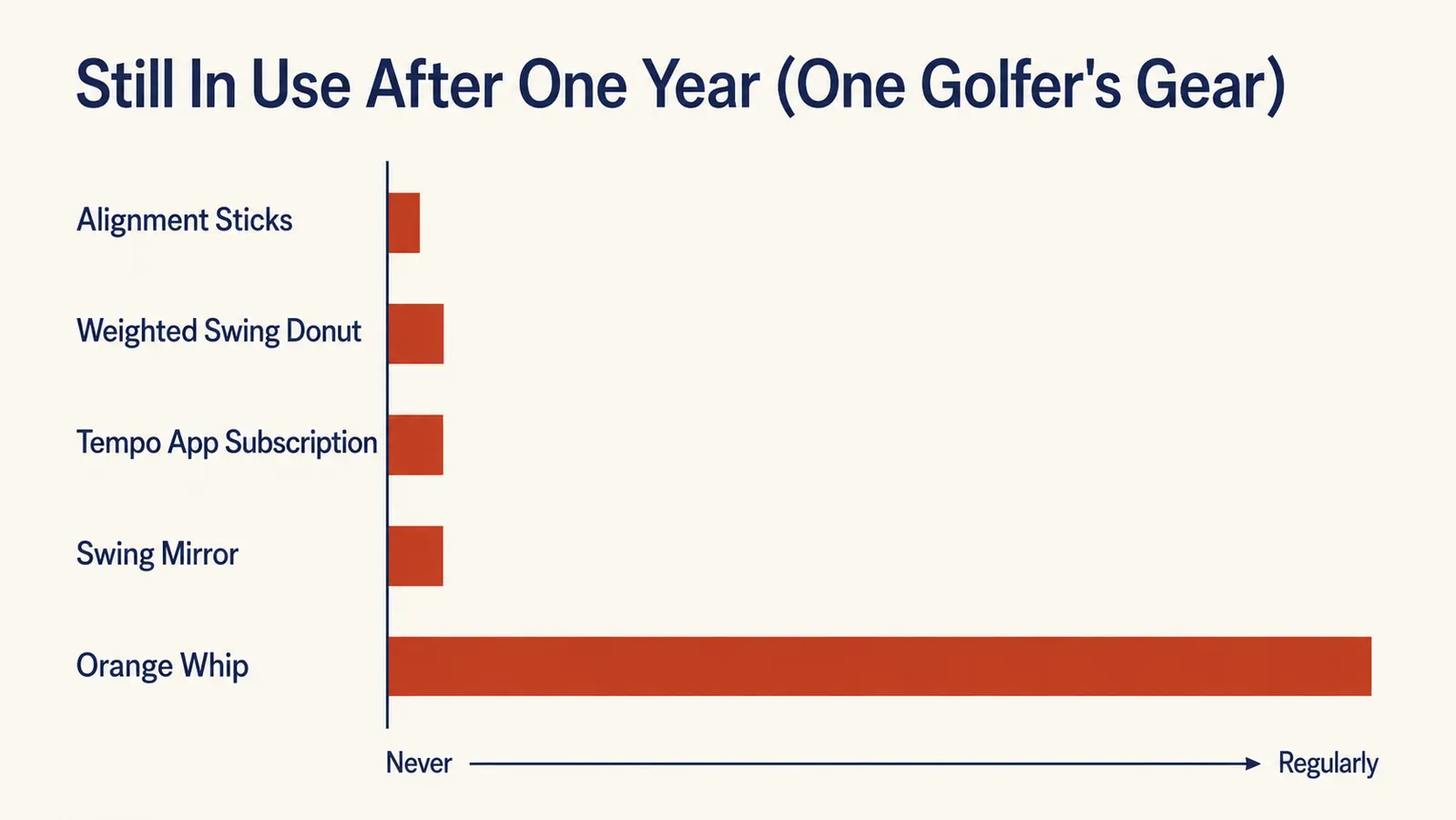
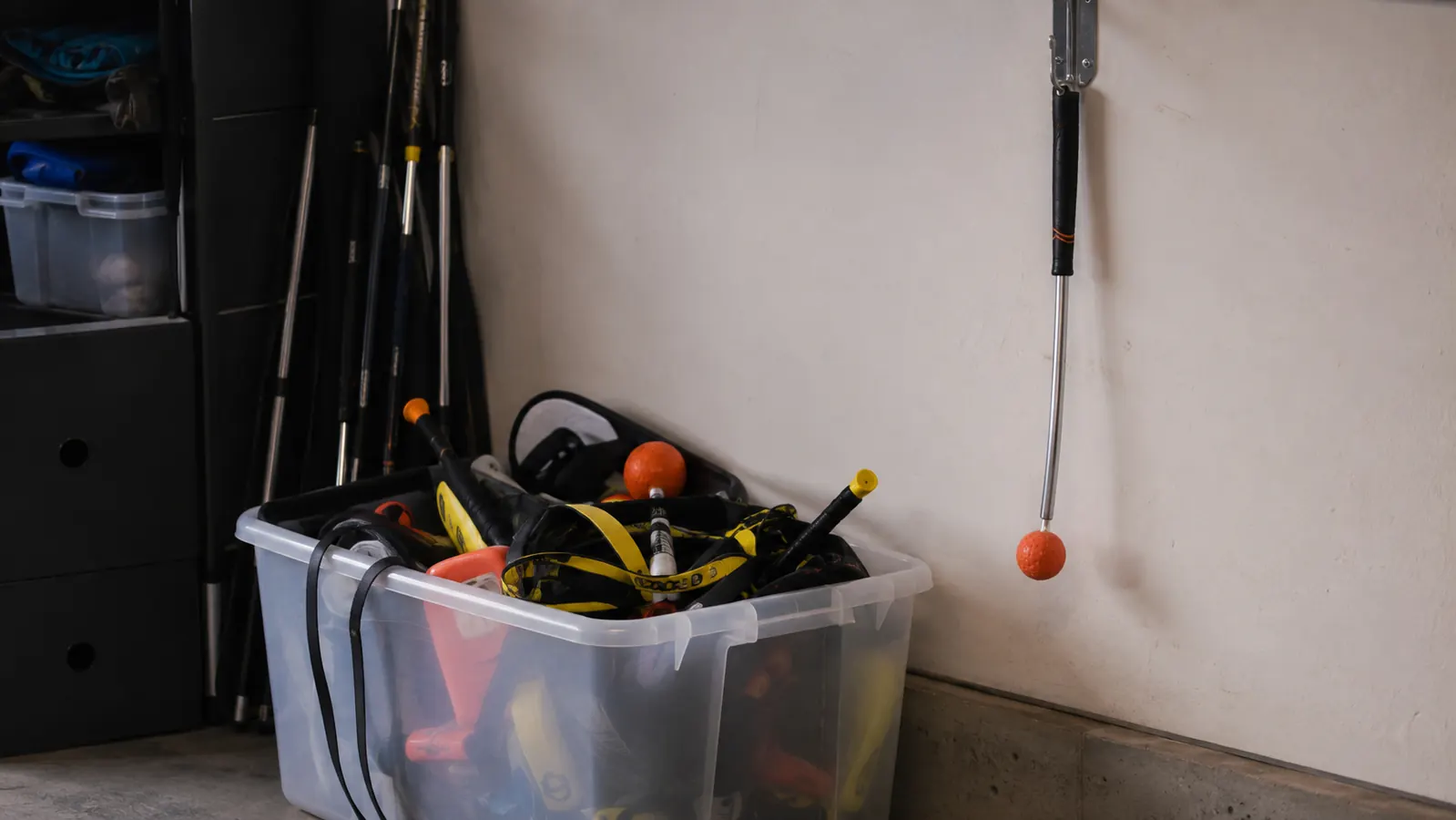
I have a plastic storage bin in the corner of my garage that I've started calling the graveyard. It's got a set of alignment sticks I used maybe six times, a weighted swing donut that slides onto a real club shaft, a tempo training app I paid for a monthly subscription to and opened exactly three times before canceling, and a swing mirror I bought with good intentions and never once set up because it needed more wall space than I actually have. Every one of those seemed like a smart purchase at the time. Every one of them stopped getting used within a few weeks.
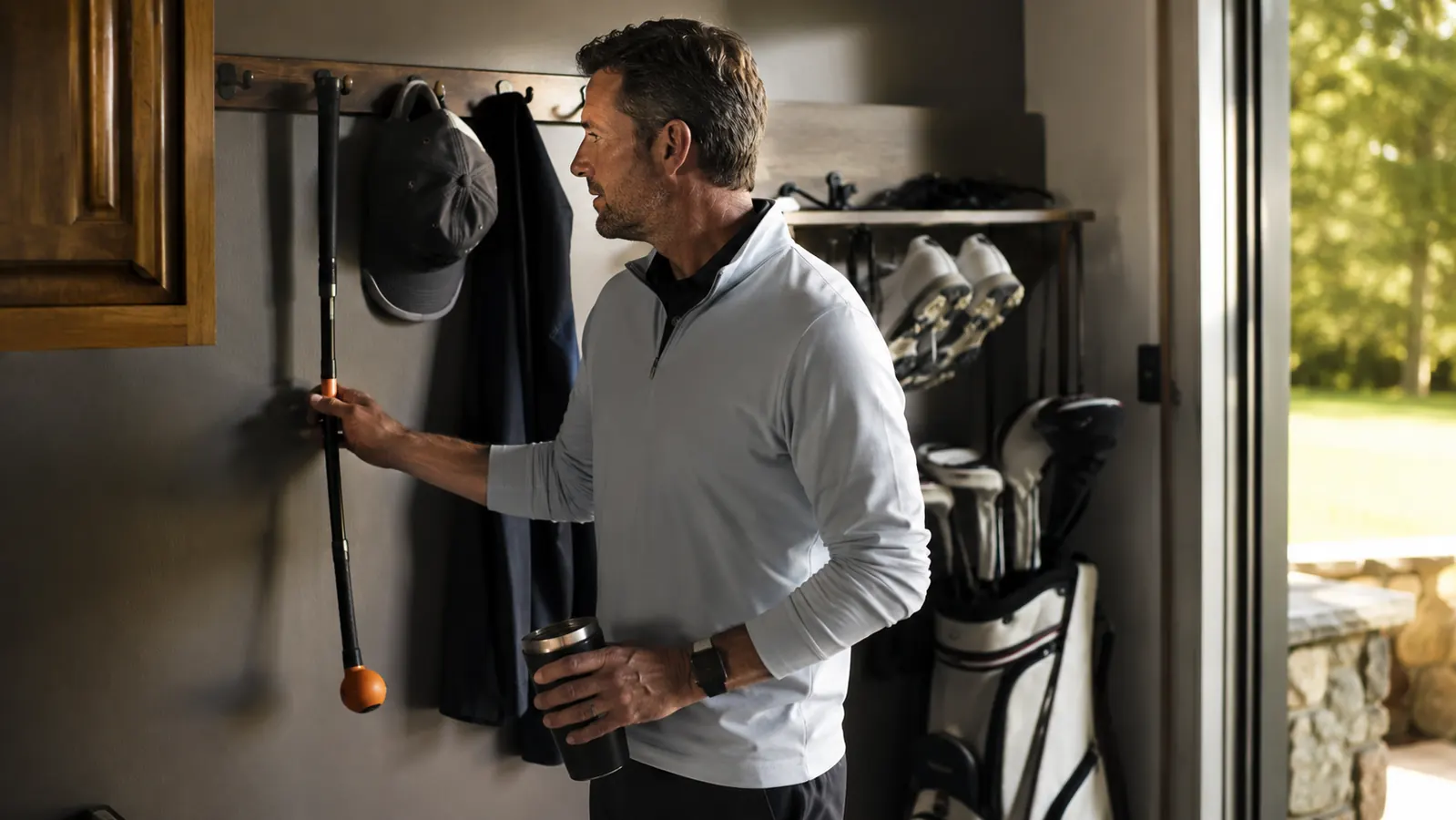
The Orange Whip is the one exception. I bought it about fourteen months ago, and it's still in rotation, hanging on a hook by the door I leave through most mornings. That's the actual subject of this review. Not whether the Orange Whip can theoretically improve a golf swing, because plenty of training aids can theoretically do that. The real question, the one nobody selling these things wants to answer honestly, is whether you'll still be using it a year in. Most people won't, and I want to talk about why, and about the specific reasons this one survived when the others in that bin didn't.
The Quick Verdict
A well-built training aid that earns its keep because it's hard to quit using, not because it's magic, and that distinction matters more than most reviews admit.
Amazon Check Today's Price →Most swing trainers get used twice and forgotten. This is the rare exception.
If you've bought a training aid before and quietly stopped using it within a month, the Orange Whip is worth understanding before you write off the whole category. Check today's price and current availability on Amazon.
Amazon Check Today's Price on Amazon →How I Actually Judge These Now
I used to review training aids the way most sites do, by asking whether the mechanism made sense and whether my swing felt different after a session or two. I don't trust that method anymore. Almost anything feels different after a session or two, including things that do nothing for you long term, because you're paying close attention to your body in a way you normally don't. The interesting question isn't day one. It's month six, month ten, month fourteen, whenever the novelty is completely gone and the only thing keeping you using it is whether it still earns the ninety seconds.
So at this point I judge a training aid mostly on retention, the same way you'd judge a habit tracker or a piece of workout equipment. Does it still get touched once the excitement of a new purchase has worn off completely. I don't have a spreadsheet or an app tracking this, I'm not that disciplined about it, but I can tell you honestly that the Orange Whip gets picked up somewhere between three and five times most weeks, usually for a minute or two at a time, and it's been doing that since roughly the second month I owned it. That's a real drop from how often I used it in the first few weeks, and I think that drop is normal and worth being honest about rather than pretending the enthusiasm never fades.
What matters is that it never dropped to zero the way everything else in that bin did. There's a difference between a habit that settles into a lower, sustainable rhythm and a habit that quietly dies. This one settled. The others died.
Why Most Swing Trainers End Up in a Bin
None of the gadgets in my garage bin were badly made or dishonestly marketed. The alignment sticks do exactly what alignment sticks do. The tempo app had a clean interface and reasonable drills. They failed for a much more boring reason than false advertising, they created friction between me and the act of using them. The sticks needed to be assembled and laid out on grass, which meant I only used them on the rare occasions I practiced at an actual range with a bag full of clubs. The app needed my phone propped up somewhere I could see it, plus a metronome running, plus enough quiet focus that a two-minute warmup turned into a ten-minute production. The mirror needed wall space I hadn't actually measured before I bought it.
Every one of those extra steps is small on its own. Stacked together, they're the difference between something you do without thinking and something you have to decide to do, and deciding is exactly the moment most good intentions die. I don't think I'm unusually lazy about this. I think most people who buy training aids are trying to build a habit around something that requires setup, and setup is where habits go to die, whether it's a golf gadget or a home gym or a journal.
The Orange Whip skipped almost all of that. You grab it, you swing it, you hang it back up. There's no assembly, no app to open, no surface to clear off first. It removed the decision entirely, which turned out to matter a lot more than any specific claim about tempo or balance printed on the box.
What Makes It Physically Harder to Quit
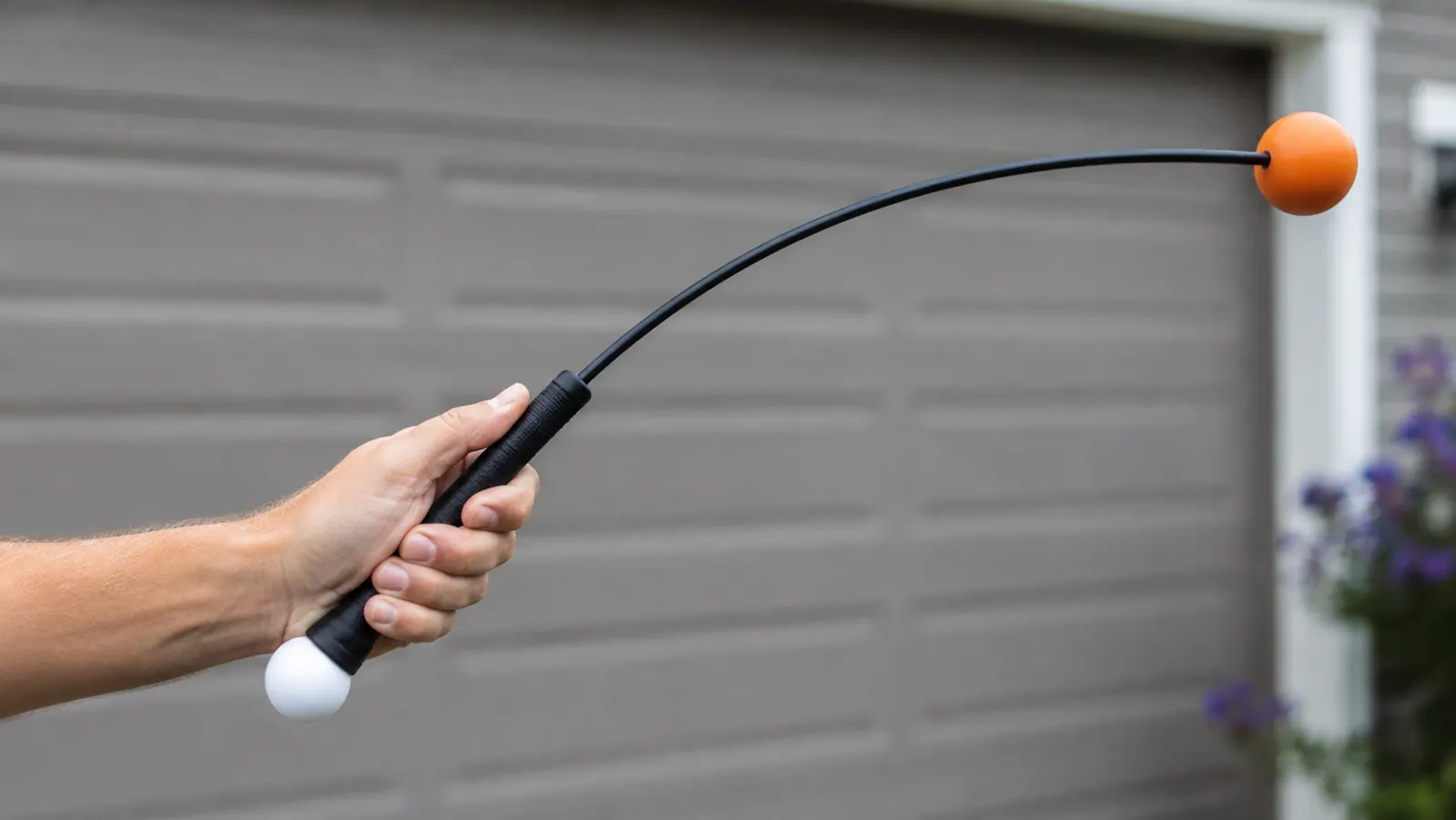
Beyond the low friction of grabbing it off a hook, there's a second reason this one stuck around that I didn't appreciate until I'd owned it a while, the feedback is built into the object instead of depending on you paying attention. The weighted orange ball on the flexible shaft doesn't care whether you're mentally checked out. If your sequencing is off, the ball whips ahead of the shaft and the whole thing feels unstable in your hands whether you were watching your form or thinking about your grocery list. You don't need a coach, a mirror, or a metronome to know something went wrong, your hands know instantly.
That's a meaningfully different design than most of the gear in my bin, which required me to actively evaluate my own form to get any value. The alignment sticks only tell you something if you look down and check your feet against them. The app only tells you something if you're watching the screen. The Orange Whip tells you something the instant you swing it badly, without any extra attention from you. Low-effort feedback is a big part of why a low-effort habit survives.
It also helps that it's satisfying in a small, almost mindless way once you get a clean rep, the ball loads and releases smoothly and the whole motion feels good in a way that's hard to describe but easy to notice. That's not a swing improvement, it's just a pleasant physical sensation, and I think it's underrated as a reason people keep doing anything repetitive. Workout routines that feel good in the moment get repeated more than ones that are theoretically more effective but feel like a chore.
The Honest Limits
None of this means the Orange Whip is a swing fix. It's a training aid that rewards a smoothly sequenced motion and punishes a rushed one, and that's a genuinely useful thing to reinforce, but it has no idea whether your grip is wrong, whether your clubface is open at impact, or whether your setup is putting you in a bad position before you even start the swing. I still hit bad shots. Plenty of them. This tool didn't touch the mechanical stuff that requires an actual set of eyes watching you swing a real club at a real ball.
There's also a real con here that most reviews gloss over because it's not as dramatic as saying a product fell apart, it doesn't measure anything for you. There's no companion app, no number, no score. You get a physical feeling and nothing else, which is exactly what makes it low friction to use but also means you're relying entirely on your own sense of whether something changed. If you're the kind of person who needs a number going up on a screen to stay motivated, this will feel unsatisfying no matter how well it works, because it was never built to give you one.
It also genuinely needs open space to swing safely, more than I expected when I first unboxed it. I can't use it in a hallway or a cramped garage bay with a car parked in it, I need enough clearance on all sides that the shaft and ball won't clip a shelf or a car mirror. On mornings when both cars are home and the garage is tight, I end up skipping it or taking it out to the driveway instead, which is a minor thing but it's the one real logistical annoyance I've run into consistently.
Who Actually Sticks With It
From what I've seen in myself and from talking to a couple of guys in my Saturday group who also picked one up after watching me use mine, the people who keep using this long term are the ones who already have some kind of low-key morning routine it can attach itself to, coffee brewing, getting dressed, walking out to the car. If grabbing it takes zero extra planning, it survives. The guys in my group who kept theirs longest are the ones who put it somewhere they'd physically walk past every day, not tucked in a closet where you have to remember it exists.
It also seems to stick with people who care more about feel than data. If you're the type who's happy trusting your own sense that a swing felt smoother versus one that felt rushed, without needing a chart to confirm it, you'll get along fine with this. That's a real personality difference, not a moral one, but it matters for whether this specific tool is going to earn a place in your routine.
Who Wastes Their Money on This
The other guy in my group who bought one after seeing mine barely uses his anymore, and when I asked him why, his answer was basically that he put it in his trunk intending to use it before rounds, and a thing in your trunk is a thing you forget exists. If you're buying this planning to use it only at the range or only before a round, rather than folding it into something you already do daily at home, I think you're much more likely to end up exactly like him, with a perfectly good training aid gathering dust in a car.
It's also money wasted if your actual problem is something this can't touch. If you already know your miss is a slice caused by an open clubface, or your grip is fundamentally off, spend the money on a lesson instead. This tool has never once told anyone what's wrong with their grip, and it never will.
What I Liked
- Zero setup, so the daily habit actually has a chance of surviving past week two
- Built-in feedback through the shaft and ball, no app or mirror required to know something went wrong
- Fourteen months in and it's the only training aid I own that's still getting regular use
- Feels satisfying enough on a clean rep that it doesn't feel like a chore
- Solid build quality, no wear or looseness after well over a year
Where It Falls Short
- No app, no score, no number, purely feel-based feedback
- Needs real open space to swing safely, a tight garage or car parked wrong rules it out
- Does nothing for grip, clubface angle, or setup issues
- Value depends entirely on where you store it, a trunk or closet kills the habit fast
- Not the cheapest training aid on the shelf, so a low-use outcome stings more
It's not the mechanism that makes this one different. It's that I still use it fourteen months later, and almost nothing else I've bought can say that.
Who This Is For
This is for anyone who's bought a training aid before, meant well, and quietly stopped using it within a month, and who's honest enough to admit that pattern is the actual obstacle rather than any flaw in the last gadget they bought. If you can put it somewhere you'll walk past daily and you're comfortable trusting feel over data, this is a genuinely low-risk way to build a habit that a lot of fancier gear fails to create.
For more on what it actually changes in your swing over a longer stretch, our long-term review goes into the tempo and balance results in detail.
Who Should Skip It
Skip it if you need a number, a score, or a graph to stay motivated, or if your problem is mechanical rather than a tempo and sequencing issue. Skip it too if you know yourself well enough to know it's going to live in your trunk or a closet, because the whole benefit disappears the moment it's out of sight. If you want the more personal version of how someone actually talked themselves into buying one, one golfer's story of buying it is worth reading before you decide.
The gadgets that survive aren't the fanciest ones, they're the ones you'll actually grab.
If you're tired of buying training aids that end up in a bin within a month, this is worth trying specifically because it's built to remove the excuses that kill most habits. Check today's price and current stock on Amazon.
Amazon Check Today's Price on Amazon →