

I've had the Peltor Sport Tactical 500 for two seasons now, and most of what gets written about these earmuffs reads like it was pulled straight off the box. Great Bluetooth. Comfortable. Cuts the noise. All technically true, and none of it tells you what actually happens once you're wearing a pair every Saturday night at Redbud Speedway, our local short track fifteen minutes from the house, with my son Theo next to me trying to hear the announcer over four cylinders coming off turn two. I bought this pair because the description promised Bluetooth audio and a working microphone without giving up the noise reduction, and on paper that sounded like exactly what I wanted. After a season and a half of actual use, I still think the core idea is right. I also think there are three or four things I wish somebody had told me before I paid for them, and that's what this review is actually about.
This isn't the long-term wear piece I already wrote about wearing these to a full season of races. That one covers how the padding, the clamping force, and the battery held up over time. This one is the version I'd want to read if I were still deciding whether to buy, the version that talks about the Bluetooth connection, the button layout, and the parts of daily use the spec sheet doesn't mention at all.
The Quick Verdict
The Bluetooth genuinely earns its keep at a loud short track, but the button layout and phone-in-pocket dropouts are real enough that I wouldn't call this pair effortless.
Amazon Check Today's Price →Wondering if the Bluetooth on these is actually worth the extra money?
Short answer: mostly yes, with a couple of catches worth knowing before you buy. The Peltor Sport Tactical 500 pairs Bluetooth audio with electronic hearing protection, and once you know where the buttons are and how to keep your phone from cutting the connection, it does what it's supposed to. Check today's price on Amazon and see current availability.
Amazon Check Today's Price on Amazon →How I've Used It
I wear this pair mostly at Redbud Speedway, our local short track, most Saturday nights from spring through the fall, plus a handful of trips to a public shooting range with my brother-in-law and a couple of afternoons in the garage running a table saw on a woodworking project I never quite finish. That's a different pattern than a handful of big race weekends a year. It's closer to weekly use, on and off, charged Sunday night and grabbed off the shelf on the way out the door Saturday afternoon, which is exactly the kind of ordinary routine most reviews skip over in favor of a single dramatic test.
Theo comes with me to Redbud most weeks. He's fourteen now and has his own pair of basic passive earmuffs, but he borrowed mine for a stretch of races this summer when his broke a hinge, and that gave me a chance to watch someone else fumble through the same learning curve I went through when I first got these. Watching him hunt for the volume button in the dark bleacher lights, without being able to see the muff on his own head, told me more about the actual design than any spec sheet ever did.
The short track setting matters here too. Redbud is loud in short, sharp bursts rather than the steady wall of sound you get at a bigger oval, cars coming off turn two, a caution flag, engines idling in the pits between heats. That stop-and-start pattern is where I noticed the Bluetooth features the most, because I was constantly switching between wanting the ambient pass-through up to hear the announcer and wanting music or a call running during a long caution, and that's exactly the kind of switching where the button layout starts to matter.
Redbud runs rain or shine more often than I expected before I started going every week, and that means these earmuffs get worn in everything from a dry, dusty August night to a cool, damp October one with fog rolling in over the front straight. I haven't noticed any real difference in how the electronics perform between those extremes, which is one thing I'll give the marketing credit for getting right. The Bluetooth pairs just as fast at forty degrees as it does at eighty, and the pass-through mode sounds the same either way. It's really the buttons and the pocket habit, not the temperature, that decide whether a given night goes smoothly.
The Bluetooth Feature Nobody Warns You About
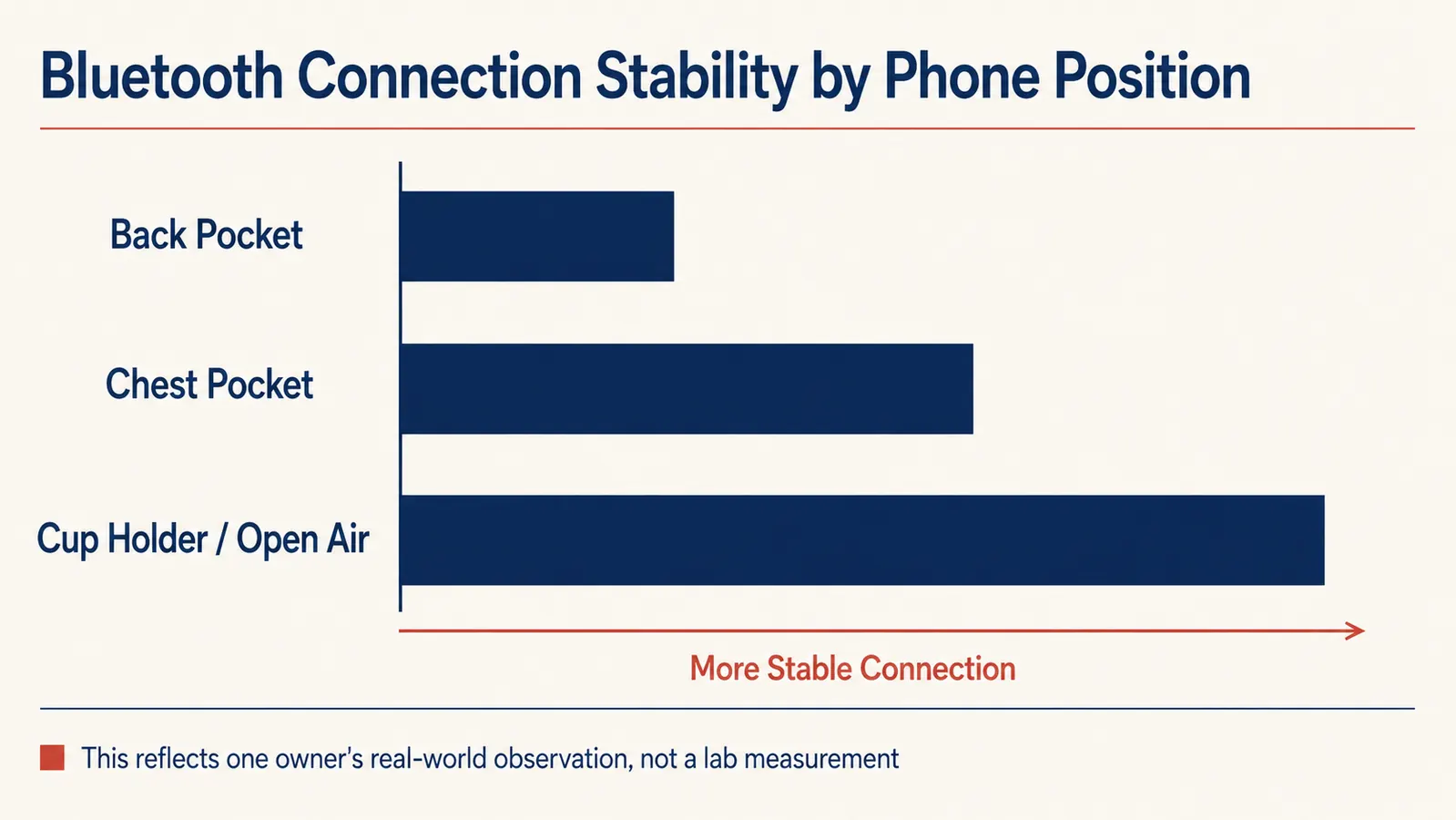
Pairing itself is simple and reliable. A long press on the power button, a quick trip to my phone's Bluetooth menu, done, every single time across two seasons. That part of the marketing is accurate and I have no complaints about it. What nobody mentions is what happens once you're actually paired and moving around a bleacher full of people, coolers, and kids climbing over each other. My phone rides in my back pocket most nights at Redbud, and I noticed the connection would drop or stutter noticeably more often when my phone was in my pocket than when it sat on the bleacher seat next to me or in a cup holder.
I don't think this is unique to Peltor. Bluetooth signal strength drops when a phone is against your body instead of in open air, and a back pocket at a crowded bleacher, with dozens of other phones and a metal grandstand structure around you, is about as bad an environment for a clean signal as you can put together. But it's also exactly the situation most people wearing these at a race are actually in, phone in a pocket, hands full of a drink or a scorecard, and it's the kind of real-world detail that never shows up in a five-minute demo video filmed in somebody's quiet living room.
My workaround now is simple: phone in a chest pocket or a cup holder, never a back pocket, and the dropouts mostly went away. It's not a flaw that ruins the feature. Music and scanner audio both sound good once the connection is stable, clear enough to actually enjoy between heats rather than just tolerate. But it's a habit you have to build, and it would have saved me a few frustrating nights if the manual had just said so plainly instead of making Bluetooth sound like something you pair once and forget about.
Noise Reduction at a Short Track, Not a Big Oval
Peltor lists this pair at 25 dB NRR, the manufacturer's own laboratory rating, and I'm not going to tell you what that number means for anyone's ears or make any claim about what's safe. What I can describe is what a Saturday night at Redbud actually sounds like through them. A local short track doesn't have the sustained roar of a bigger event, it's closer to a series of loud spikes as cars pass, so the pass-through mode matters more here than it might somewhere with constant noise, because you're toggling between wanting quiet during a green flag run and wanting to hear the person next to you during a caution.
Compared to the basic passive muffs Theo wore before his pair broke, the difference at Redbud is obvious inside a single race. He could hear me ask him a question without either of us shouting or pulling anything off, and I could still hear the cars clearly enough to follow the race instead of just feeling it. That's the actual selling point of electronic hearing protection at a smaller track where the crowd is thinner and conversation matters more than it would in a packed grandstand at a bigger event.
Buttons You Can't Find By Feel
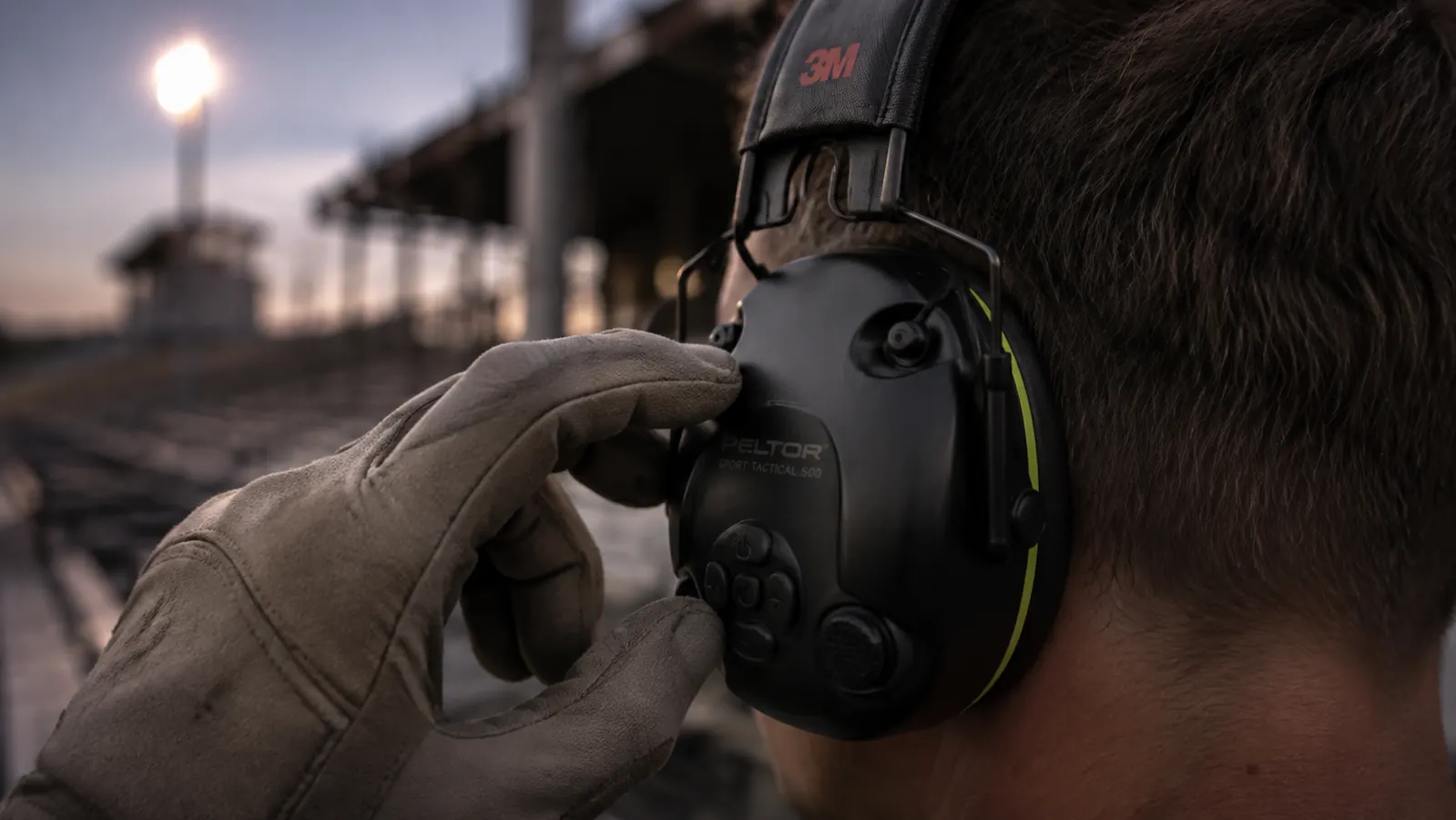
This is my biggest complaint after two seasons, and it's the one I almost never see mentioned anywhere. The power button, the volume rocker, and the Bluetooth talk button all sit close together on the right earcup, and they're similar enough in shape and size that finding the right one without looking at it is genuinely difficult, especially in bleacher lighting at dusk or with cold hands in the fall. More than once I've reached up expecting to bump the volume and accidentally hit the power button instead, killing the pass-through mid-race and leaving myself briefly deaf to everything around me until I sort out what happened.
Gloves make it worse. On a cold October night at Redbud, thin gloves are enough to blur the already subtle differences between the buttons, and I've ended up pulling a glove off just to make a simple volume adjustment more times than I'd like to admit. A set of raised ridges, a different texture, anything that let you find the right button by feel alone would fix this completely, and it's the kind of thing that feels like an obvious oversight once you've actually lived with the product instead of just reading the spec sheet.
Theo ran into the same mix-up on his own within his first hour wearing mine. He meant to turn the volume down during a loud green flag run and instead powered the whole unit off, sitting there confused for a few seconds before he realized the pass-through had gone completely silent instead of just quieter. He handed them back to me at the next caution and said he'd rather deal with his own passive pair than relearn a button layout mid-race. That's a fourteen-year-old's honest reaction to the exact same problem I've had, and it told me this isn't just me being clumsy with a new gadget. The layout is genuinely easy to mix up under pressure, in the dark, with something loud happening in front of you.
None of this makes the earmuffs unusable. It just means there's a real learning curve, longer than the pairing process the marketing focuses on, and it's the kind of friction that only shows up after weeks of actual use rather than a quick first impression. If you're the type who wants to glance at a product once and immediately know where everything is, budget a few nights of fumbling before it becomes automatic.
What Else I Looked At Before Buying
Before I bought this pair I looked hard at Walker's Razor Slim, which trades some bulk and clamping force for a lower profile that fits a smaller head more comfortably. Theo actually prefers the feel of a slimmer pair, which is part of why he kept reaching for his own passive set instead of asking to borrow mine full time. I also considered just sticking with basic passive earmuffs and a separate handheld scanner, which is cheaper up front but means juggling two devices instead of one, and after a season of trying to hold a scanner in one hand at a crowded bleacher, I don't think I'd go back.
The honest comparison is that the Peltor wins on Bluetooth range and the convenience of AA batteries over a proprietary charging cable, and it loses a little on button ergonomics and overall bulk compared to a slimmer passive-plus-scanner setup. Neither choice is wrong. It depends on whether you'd rather deal with two separate devices or one device with a slightly fussy button layout, and for me, one device won out even with the learning curve.
What I Liked
- Bluetooth pairing is fast and reliable every single time, no repeated setup
- Pass-through mode makes it easy to hold a conversation during a caution without pulling anything off
- AA batteries mean a dead pack is a quick gas-station fix, not a dead product
- Noticeably easier to follow a race and talk to the person next to you than with basic passive muffs
- Music and scanner audio sound clear once the Bluetooth connection is stable
Where It Falls Short
- Connection drops noticeably when the paired phone rides in a back pocket instead of somewhere open
- Power, volume, and talk buttons sit close together and feel nearly identical by touch alone
- Thin gloves make finding the right button by feel even harder on cold nights
- Learning the button layout takes real weeks of use, not a quick first session
- Bulkier on the head than a slim passive pair, which some wearers will notice right away
The pairing process is the easy part everyone talks about. Finding the right button in the dark with cold hands is the part nobody mentions.

Who This Is For
This pair makes the most sense for someone who goes to a short track regularly enough to get past the learning curve on the buttons, and who's willing to keep their phone somewhere other than a back pocket to avoid the Bluetooth dropouts. If you want to actually talk to the person next to you and hear a scanner or take a call without pulling anything off your head, and you're patient enough to build the muscle memory for the controls, it does exactly what it's supposed to. Weekly regulars like Theo and me get more out of it than someone who shows up to one race a year ever would.
Who Should Skip It
If you mostly want simple, no-fuss hearing protection and have no real interest in Bluetooth, scanner audio, or phone calls, you're paying for features you'll rarely touch, and a basic passive pair will do the core job for less money and zero learning curve. I'd also think twice if you have thick winter gloves you plan to wear most of the time, since the tightly grouped buttons are hard enough to find bare-handed, let alone gloved. And if you're not willing to change a habit as small as which pocket your phone rides in, the dropouts will probably bother you more than they bothered me.
Know the quirks going in, and the Bluetooth still earns its spot in the bag.
It took me a season to learn the button layout and stop keeping my phone in a back pocket, but once I did, this pair does exactly what the Bluetooth promises. Check today's price on Amazon before your next race weekend.
Amazon Check Today's Price on Amazon →