

I didn't buy my Callaway 300 Pro new. I found it on a golf forum's classifieds section in February for well under retail, from a guy upgrading to a newer model, and I bought it mostly to see if a laser rangefinder was worth the hype before I'd commit to paying full price for one myself. Ten months and a genuinely wide mix of rounds later, from my flat home course to a desert golf trip that pushed the thing further than I expected, I've got opinions that don't match the five-star glow you'll find on most review pages. Some of it is very good. Some of it is stuff nobody mentions until you own one.
I'm a weekend player, somewhere around a 14 handicap, and I play a flat municipal course near home most Saturdays plus whatever trips come up. This isn't a review from someone who plays five days a week and needs tour-level precision. It's from someone deciding whether a mid-priced gadget actually changes anything for a normal golfer, or whether it's just a nicer version of guessing.
The Quick Verdict
Accurate and fast when it matters, but the battery warning system is a real weak point and the price only makes sense if you play often enough to use it.
Amazon Check Today's Price →Before you invest in a premium rangefinder, know exactly what you're getting.
No hype here, just what actually happened over ten months of real rounds. If you want the fast, one-second flag lock without the guesswork, check today's price and current availability on Amazon.
Amazon Check Today's Price on Amazon →How I Actually Use It
My home course is about as flat as golf courses get, which honestly isn't the ideal proving ground for a slope-capable rangefinder. Most weeks I'm using it the same simple way: pull it out at the tee box on a par 3, use it again from wherever my second shot sits on a par 4 or 5, and that's it. No elevation drama, no wind reading required most days, just a straightforward number to the pin instead of trusting a 150-yard marker that's usually a rough guess anyway.
The bigger test came in March, when four of us flew out for a five-day golf trip near Scottsdale. Desert courses are a different animal from what I'm used to. Distances play differently in dry air, the fairways are lined with washes and rock instead of trees, and more than a few holes had me completely unsure where the actual hazard lines sat. Having a laser that could pick out a flag from 200 yards away against a background of tan sand and scrub, instead of green grass, mattered more on that trip than it ever has at my home course.
I also loan it out more than most reviews account for, since two of my regular group don't own one and ask to borrow mine on a hole here and there. That extra handling, other people's grip habits, other people forgetting to put it back in the case, is its own kind of stress test, and it's part of why my honest take differs a little from the glossy first impressions you'll read elsewhere.
The desert trip also taught me something about how this rangefinder handles glare. Between about ten in the morning and two in the afternoon out there, the sun sits high enough that the display can wash out if you're not shading it with your free hand, which is a habit I didn't have back home where the light is softer most of the year. Once I got in that habit it stopped being an issue, but it's the kind of small adjustment nobody tells you to expect until you're squinting at a blank-looking screen on the tee box while your group waits on you.
The Battery Warning Nobody Mentions
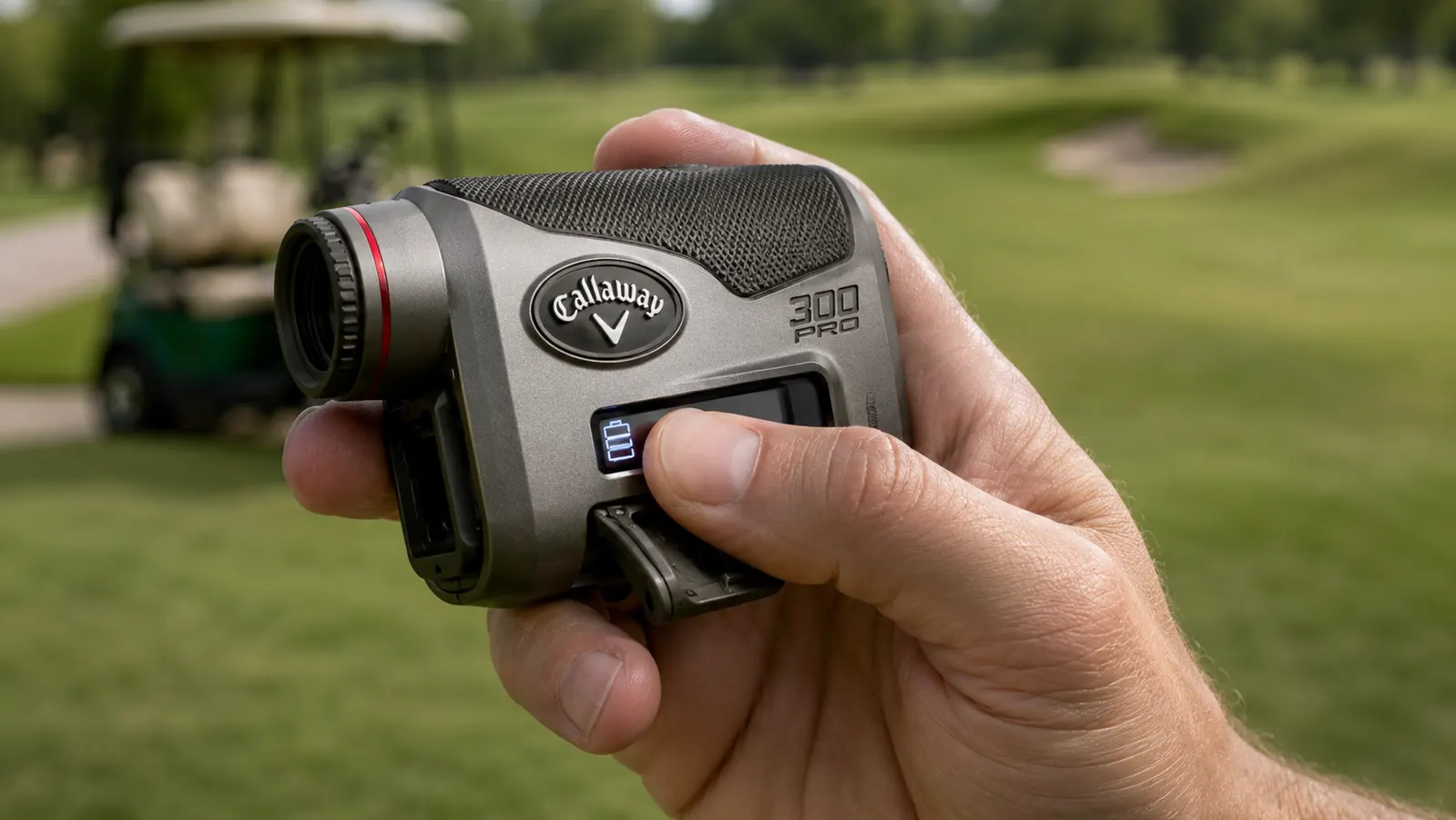
This is the thing that surprised me most, and it's not in any marketing copy I've seen for this unit. The battery indicator on the display shows exactly two states: a full icon, and a flashing empty icon. There's no half-charge warning, no percentage, nothing in between. Since I bought this used, I don't know how old the battery was when I got it, but what I do know is that it showed a full icon on the Scottsdale trip and then, less than three weeks later during a normal Saturday round at home, it started flashing empty mid-round with zero warning beforehand.
That left me finishing the back nine on guesswork again, which is exactly the problem I bought this thing to solve. A two-state indicator like this means you either carry a spare battery in your bag at all times, which I now do, or you accept that you'll eventually get caught with a dead unit at the worst possible moment. For a premium-priced device, I expected better battery telemetry than my kid's old handheld game console had fifteen years ago.
Accuracy: Good, Not Magic
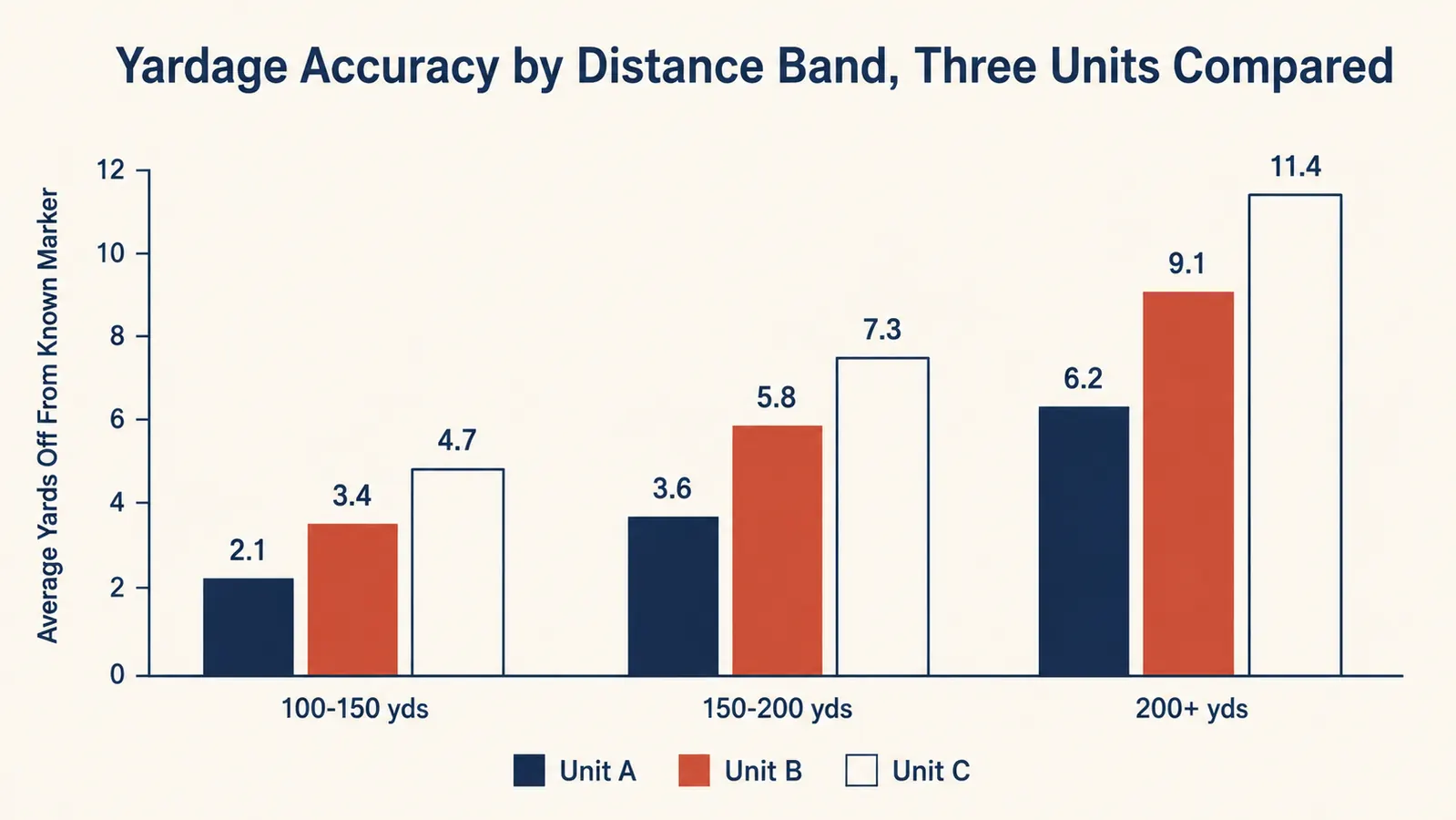
I want to be straight about this because I think a lot of reviews oversell how big a deal laser accuracy actually is. On the Scottsdale trip, I borrowed a buddy's Precision Pro NX9 for a few holes just to compare the two side by side, since he'd brought his along and we were curious. On flags under 150 yards, both units gave me the same number or landed within a yard of each other every single time. Past 200 yards with a busy background, like rock formations or distant trees behind a green, both units occasionally needed a second try to lock the actual flag instead of grabbing something behind it. Neither rangefinder was clearly better at that distance.
So the honest answer is that this specific model isn't dramatically more accurate than other established laser rangefinders in a similar price range. What you're really paying for is the Callaway name, the slope switch feature if you use it, and a build that felt solid in hand during the comparison. If pure yardage accuracy at short range is your only concern, a cheaper non-slope laser will likely get you there too. I'll say more about where the slope feature actually earns its cost below, because that's where this unit separates itself a bit more.
One thing I will give this unit credit for is consistency. Across roughly forty rounds since February, spread across four different courses, I never once got a reading that was obviously wrong once locked. The occasional miss-lock on a distant flag against a cluttered background always announced itself, the display would show a number that was clearly too short, like it grabbed a bush instead of the pin, and a quick re-aim fixed it in a second or two. It never silently fed me a wrong number without some visual clue that something was off.
The Slope Switch Trap Nobody Warns You About
My regular playing partner has a teenager who plays on the high school golf team, and last fall he asked to borrow my rangefinder for a qualifying round. I had to tell him no. His tournament's local rules ban any rangefinder with slope capability from the golf bag entirely during a scored round, whether the slope function is switched on or off. We'd both assumed flipping the external switch to the off position would be enough to make it legal. It isn't, at least not under the rules his tournament used, and that's a distinction that isn't obvious unless you actually read the fine print or get burned by it.
If you're buying this as a gift for someone who plays competitively, or if you yourself play in any rated events, this is worth checking before you spend the money. Callaway makes a non-slope version of this same rangefinder that avoids the whole issue, and if tournament play is a real part of your golf, that's genuinely the smarter buy even though it means giving up a feature that's otherwise useful on hilly rounds.
The Heat Problem I Didn't See Coming
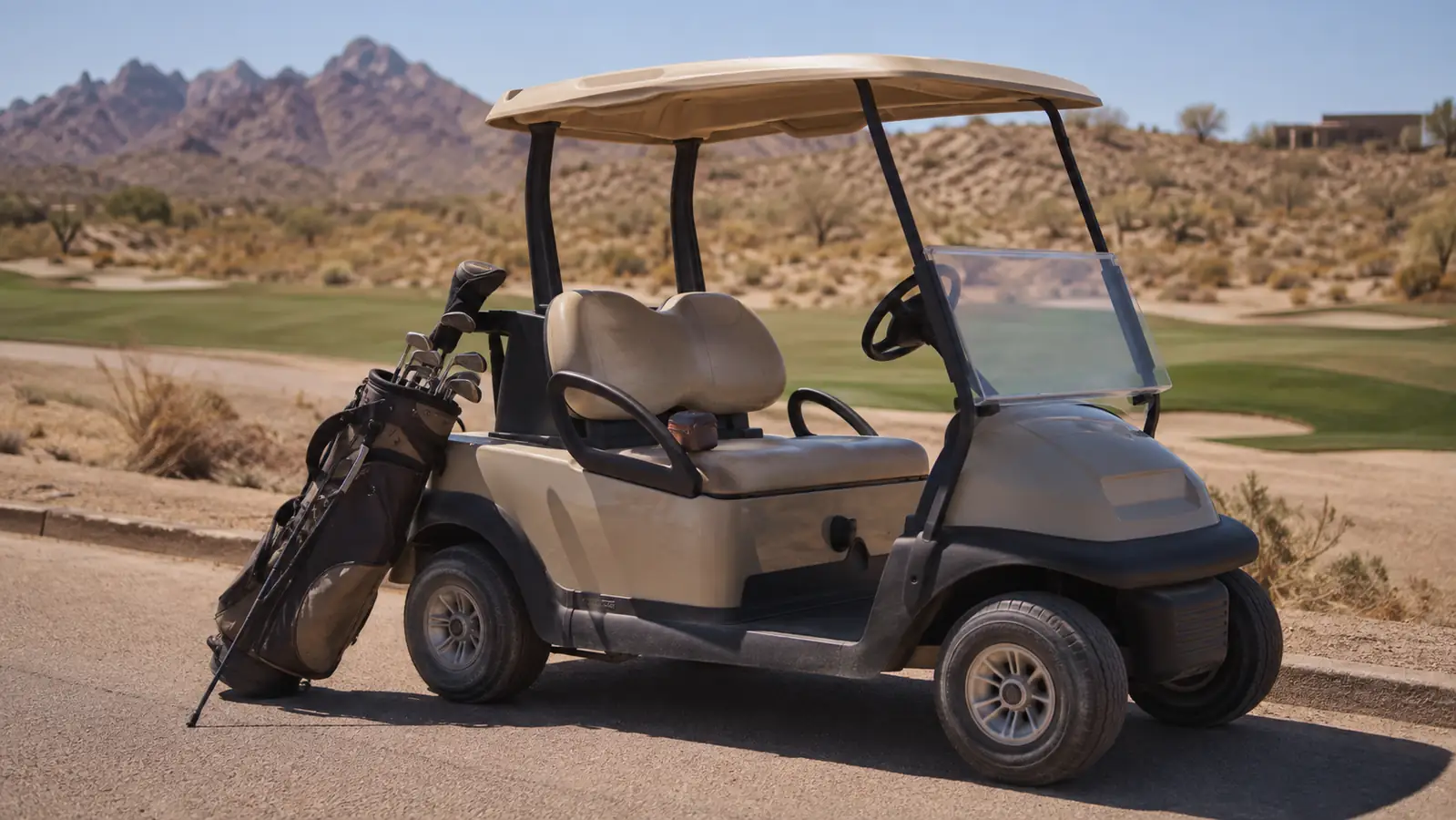
On day three of the Scottsdale trip, I left the rangefinder in its case on the cart seat during a lunch stop instead of carrying it into the clubhouse, and the cart sat in full sun for close to an hour with highs around 100 degrees that week. When I picked it back up, the unit itself was noticeably warm to the touch, and the display was sluggish for the first minute or two, slow to refresh and a little dim compared to normal. It came back to full function once it cooled down riding in the cart with the cover half open, and I never saw the issue again for the rest of the trip once I started keeping it in my bag pocket instead of loose on the seat.
I haven't seen this specific quirk mentioned anywhere else, probably because most reviews get written by people testing gear somewhere temperate, not somewhere that regularly hits triple digits. If you golf in genuine desert heat, treat this rangefinder the way you'd treat your phone: don't leave it baking in direct sun longer than you have to, and it'll behave fine.
Is $170 Actually Worth It
Here's where I land after ten months with this thing in a mix of hands, courses, and climates. If you play regularly, once a week or more, the exact-flag-lock convenience adds up to real value over a season, and the slope feature is genuinely useful the moment you play anywhere with real elevation change. If you're a casual golfer who plays six or eight times a year, I'd have a hard time justifying this price over a cheaper non-slope laser or even a decent GPS watch, since the marginal accuracy gain over those options is smaller than the marketing suggests. The battery indicator issue and the tournament-legality trap are the two things that would have changed my buying decision if I'd known about them going in, and neither one shows up in the typical five-star review.
What I Liked
- Fast, reliable flag lock in almost every real-world situation, including busy desert backgrounds
- Slope-adjusted yardage genuinely useful the moment a course has real elevation change
- Held up fine to being loaned out repeatedly to other players in my group
- Comparable short-range accuracy to a pricier competitor unit in a direct side-by-side test
- Solid, grippy build that survived a hot desert golf trip without any lasting issue
Where It Falls Short
- Two-state battery indicator gives zero warning before it dies mid-round
- Slope switch, even off, disqualifies it from some tournament and qualifier rules entirely
- Display gets sluggish if the unit sits somewhere hot for an extended stretch
- Not meaningfully more accurate at close range than other established brands in the same price range
- Hard to justify the current price if you only golf a handful of times a year
Nobody's review mentions that the battery goes from full to dead with zero warning in between. I found that out the hard way, on the back nine, with no spare in my bag.
Who This Is For
This rangefinder makes the most sense for a regular player, someone teeing it up weekly or close to it, especially if any of your regular rounds involve real elevation change where the slope switch has something to work with. It's also a smart pick if you travel for golf even once or twice a year to courses you've never played, since the exact-yardage confidence matters most exactly when you don't already know the holes by memory. I'd recommend keeping a spare CR2 battery in your bag from day one, which solves the only real functional weakness I ran into.
Who Should Skip It
Skip this if you play in tournaments or qualifiers where any slope-capable rangefinder is banned regardless of switch position, since you'll want the dedicated non-slope model instead. Skip it too if you're an occasional golfer who tees it up a handful of times a summer, since a cheaper non-slope laser or a free GPS app will get you close enough for casual rounds without the added cost. And if you're buying this specifically for someone who plays competitively without checking their tournament's rangefinder rules first, do that check before you spend the money. It would have saved a conversation I didn't want to have with a disappointed teenager the morning of a qualifying round.
I also priced out what a brand-new unit would have cost me versus what I actually paid secondhand, and the gap was significant enough that I'd point anyone on a budget toward the used market first. Golf forums and local trade groups turn these over pretty often when someone upgrades to a newer model, and a lightly used unit with a fresh battery installed is arguably a better buy than a brand-new one at full retail, assuming the seller is upfront about condition.
If you play often enough to notice the difference, it's worth the money. If you don't, it isn't.
That's the honest verdict after ten months of real use in real conditions, no marketing spin. Check today's price and current stock on Amazon before deciding.
Amazon Check Today's Price on Amazon →