
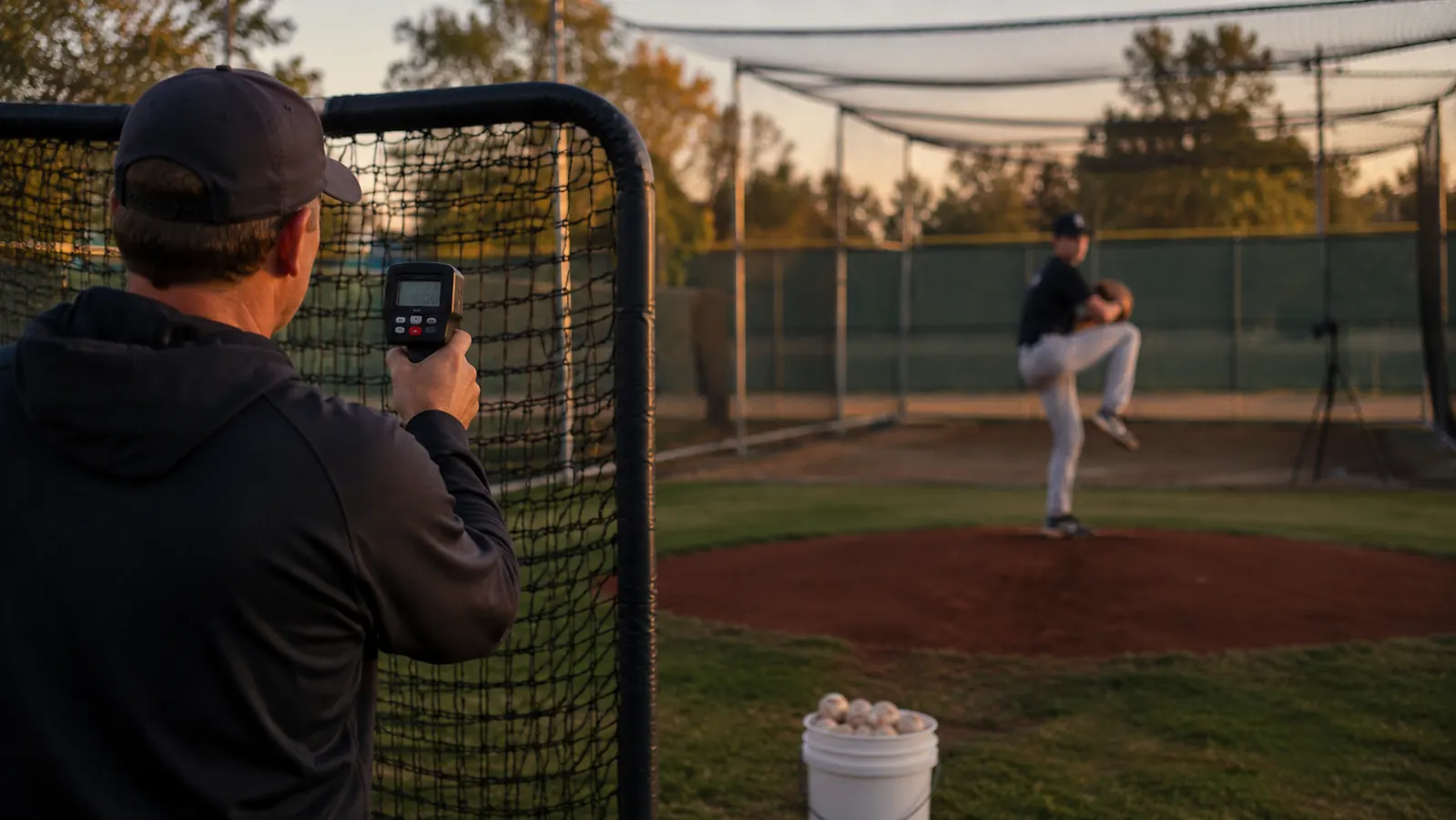
If you clicked this hoping I'll tell you the Pocket Radar Smart Coach beats the Blast Motion swing sensor, or the other way around, I'm going to disappoint you in the first paragraph. They don't really compete. One is a radar gun. It tells you how fast a ball is traveling, off a mound or off a bat. The other is a small sensor that clips onto a bat knob and tells you how the swing itself moved to produce whatever speed showed up. I've used a Pocket Radar Smart Coach behind an L-screen for two full seasons of my son's bullpens, and I borrowed a buddy's Blast Motion sensor for about six weeks this spring to clip onto my daughter's bat during softball cage work. They're built to answer two different questions, and mixing them up is how a lot of parents end up buying the wrong one.
The short version: if you're standing behind a pitcher and want a hard, trustworthy number on velocity, buy the Pocket Radar Smart Coach. It's priced in the premium range, and it does that one job better than anything else I've used at any price. If you're working with a hitter on swing mechanics, bat speed, attack angle, or time to contact, the Blast Motion sensor is the better tool and it's more affordable. If you've got a pitcher and a hitter in the same house, like I do, you'll probably end up owning both eventually, and that's the honest, unglamorous conclusion of this whole comparison.
| Pocket Radar Smart Coach | Blast Motion Swing Sensor | |
|---|---|---|
| Price (Typical Range) | Check today's price on Amazon | Check today's price on Amazon |
| What It Measures | Pitch velocity, throwing velocity, exit velocity off the bat | Bat speed, attack angle, rotational acceleration, time to contact |
| How It Attaches | Standalone handheld unit, nothing touches the bat or ball | Adhesive sensor clips onto the bat knob cap |
| Real-Time Feedback | Instant number on the unit's screen the moment the pitch crosses | Syncs to the phone app after each swing, small lag before the number shows |
| Who It Works For | Pitchers, hitters checking exit velo, catchers checking pop time | Hitters working on swing mechanics only |
| Video Integration | Basic log of readings over time in the companion app | Swing metrics overlaid directly onto slow-motion video capture |
| Learning Curve | Point it, get a number, done | Takes a few sessions before attack angle and time-to-contact numbers mean anything useful |
| Outfitting a Whole Team | One unit covers every player who steps into the box or onto the mound | Works best with one sensor per player, which adds up fast for a full roster |
How I Actually Tested Both
I didn't run this comparison off a spec sheet. My son is 14 and pitches for a travel team, and I've stood behind an L-screen with the Pocket Radar Smart Coach for his bullpens since he was 12, first the older model and now the Smart Coach with the app. My daughter is 11 and plays fastpitch softball, and she was the one who actually wore the Blast Motion sensor this spring, a buddy from her team's board let me borrow his kit for six weeks so I could put real cage sessions behind this article instead of a first impression from a sporting goods counter.
For the radar side, I logged every bullpen from April through the start of July, roughly 20 sessions, and wrote down his fastball readings each time rather than trusting memory. For the swing sensor side, I had my daughter wear it for three cage sessions a week for six weeks, and I sat with the app afterward comparing what it told us against what I could already see with my own eyes watching her swing. Neither test was a lab environment. Both were exactly the kind of backyard-and-cage use these products are actually sold for.
I also tried to break each device a little, on purpose, before I trusted the numbers enough to write about them. With the Smart Coach, I moved my angle behind the L-screen a few feet off center a couple times to see if the reading drifted, and it stayed within a mile or two of the straight-on number, which matched what Pocket Radar says about its acceptable angle tolerance. With the Blast Motion, I had my daughter swap bats mid-session, moving the sensor cap from her main bat to a backup, and the readings stayed consistent bat to bat, which told me the sensor is measuring her swing and not something specific to one piece of wood or aluminum.
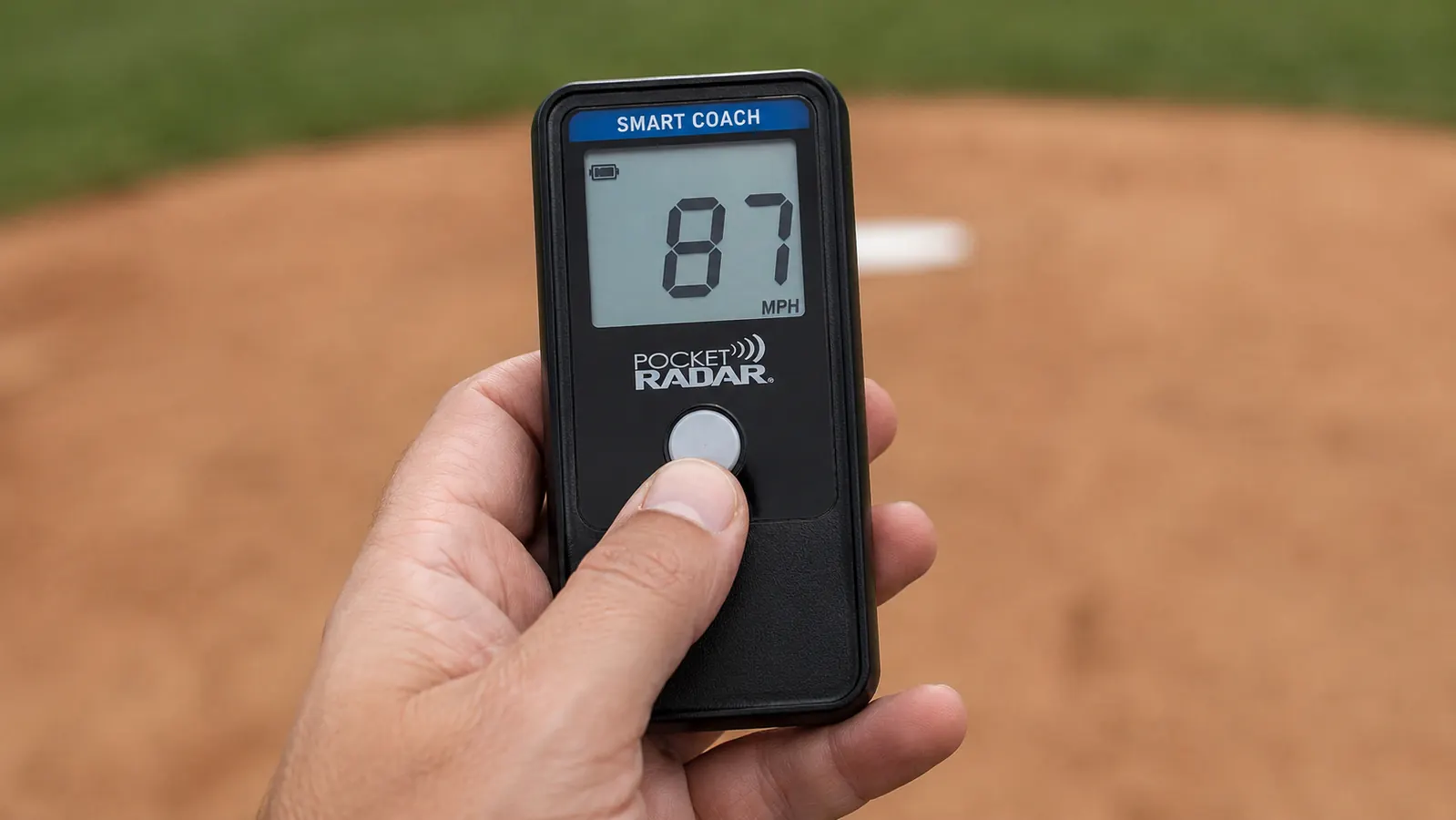
Where the Pocket Radar Smart Coach Wins
The whole reason to own this thing is velocity, and it delivers a trustworthy number without asking anything of the player. In April my son was sitting 58 to 61 miles per hour on his fastball in bullpens, and by early July, after a summer of legs and mechanics work, he was consistently 64 to 65 with a peak reading of 67 in one outing that he still brings up at dinner. That trend line, tracked the same way session after session, is the entire value of a radar gun, and the Smart Coach makes it painless. You point it, he throws, a number shows up on the small screen instantly, and it logs to the app so I'm not the one responsible for remembering six weeks of readings.
It's also useful for more than pitching, which the Blast Motion sensor simply can't do. I've pointed the same unit at exit velocity off my daughter's bat during batting practice without putting anything on her bat at all, and I've clocked pop times behind the plate at a catching clinic. That flexibility matters if you've got more than one kind of player in the house, or if you're a coach trying to get quick velocity numbers on an entire lineup during a tryout, where clipping a premium sensor onto every kid's bat just isn't realistic. One handheld unit can be passed around a whole dugout in a way a bat-mounted sensor never will be.
There's also a durability angle that doesn't show up on a spec sheet until you've dropped one. The Smart Coach has ridden in the bottom of my catcher's bag, gotten rained on during a couple of April bullpens before I learned to bag it, and survived a fall off a bucket onto a concrete dugout floor. It's still reading accurately. A bat-mounted sensor lives a gentler life by design, since it's not standing exposed to weather and gravity the way a handheld unit does behind an L-screen, but that also means the radar gun has to be built tougher just to survive where it's actually used.
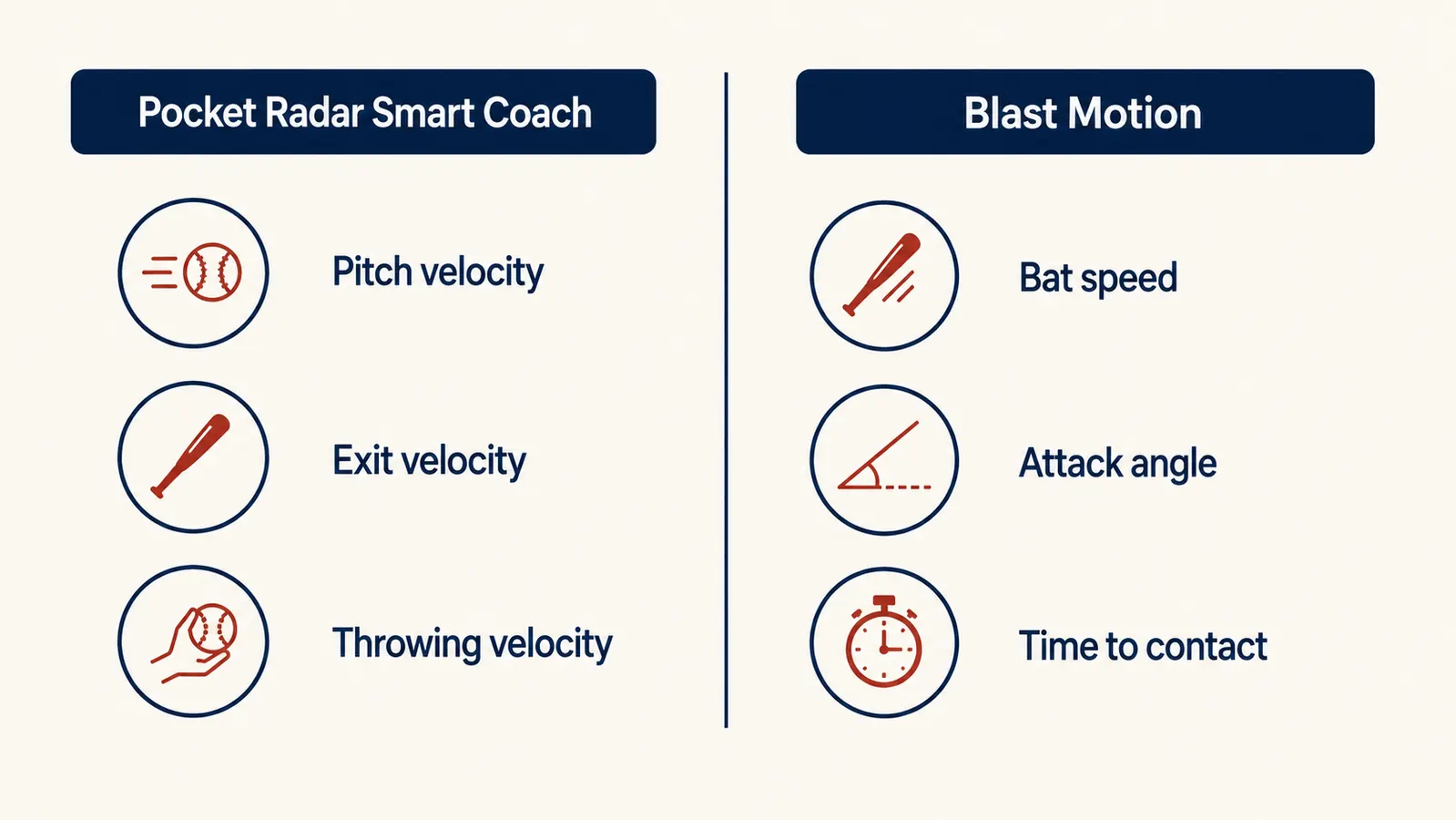
Where the Blast Motion Swing Sensor Wins
For actually fixing a swing, the Blast Motion gave us numbers the radar gun never could. My daughter had a swing that was chopping down through the zone, and her coach kept saying 'flatten it out' without much for her to measure against. The sensor's attack angle reading started around negative 4 degrees in week one, which is steep and explains the weak ground balls she'd been hitting, and by week six of cage work it had climbed to around positive 8 degrees. Watching that number move gave her something concrete to chase between sessions instead of a vague coaching cue she couldn't feel in real time.
The video overlay is the other genuine advantage. The app lays bat speed, time to contact, and attack angle right onto the slow-motion clip of the swing, so you're not staring at a number in isolation, you're watching the swing that produced it. And it works without a second person standing behind a screen operating anything. My daughter could hit alone in the cage, review her own swings on her phone afterward, and see exactly which cuts were her best without me hovering with a radar gun. For a hitter doing solo reps, that independence is worth a lot, and at roughly a third of the Smart Coach's price, it's an easier first purchase for a family that only has one kid and only needs swing data.
The lower price point also matters differently once you factor in a whole team rather than one kid. My daughter's coach eventually bought a small set of these sensors for the team to rotate through during winter cage sessions, and even outfitting four or five players cost less than a single Smart Coach unit would have. That math flips the other direction if the team is chasing pitching velocity instead, since one handheld radar gun still covers every arm on the roster, but for a hitting-focused program working on mechanics across a whole lineup, several cheap sensors beat one expensive one.
If a hard velocity number is the thing you actually need, start here.
The Pocket Radar Smart Coach is the one that stayed behind our L-screen all season. Check today's price and current availability on Amazon before you decide.
Amazon Check Today's Price on Amazon →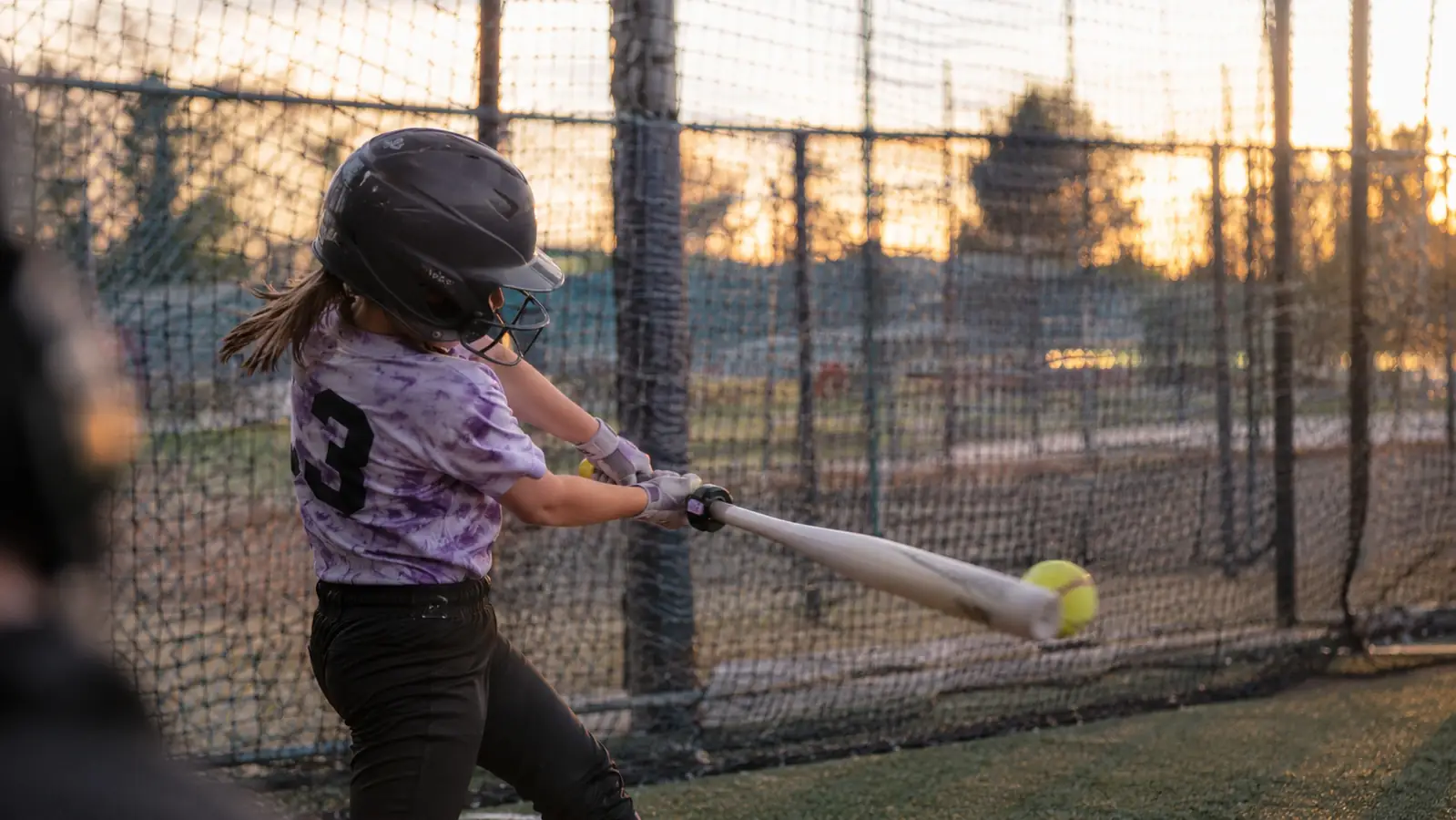
What Neither One Will Fix
It's worth saying plainly, because both companies market around this a little: neither device fixes a swing or a delivery by itself. The Smart Coach told me my son threw harder in July than April, but it had nothing to say about why, that came from his own strength and conditioning work and a coach adjusting his stride length. The Blast Motion told us my daughter's attack angle improved, but the actual fix came from repetition and a coach's eye on her hands, not the sensor itself. Both tools are measurement devices, not correction devices. They tell you whether the work you're already doing is showing up in the numbers, which is genuinely valuable, but they don't replace a coach, a tee, or a few hundred more reps.
I'd also add a caution about comparing kids to other kids' numbers rather than to their own past numbers, which is the trap both of these devices make easy to fall into. It's tempting to look up 'average exit velocity for an 11-year-old' or 'average fastball velocity for a 14-year-old' and treat that as a goal, but every player matures on a different timeline, and chasing someone else's number instead of your own kid's trend line is a fast way to make a training tool feel discouraging instead of useful. The value in both devices is watching your own player's line move over months, not comparing that line to a stranger's highlight reel.
Who Should Buy Which
If your player is a pitcher, or you coach a team and want quick velocity checks on multiple kids without buying a sensor for each one, the Pocket Radar Smart Coach is the better first purchase even at the higher price. It's also the right call if you want exit velocity or pop time data alongside pitching speed, since one unit covers all three. If your player is a hitter working specifically on swing mechanics, attack angle, or time to contact, and you want them to be able to review their own swings without a second person running the equipment, the Blast Motion is the more useful tool and the easier one to justify at its lower price point.
If you've got both a pitcher and a hitter, or one kid who does both, don't talk yourself into thinking one device will cover everything, because it won't. I resisted buying the swing sensor for over a year on the assumption our radar gun was 'basically the same kind of thing,' and it just isn't. Once I actually put a Blast Motion in my daughter's hands, the gap in what each device tells you became obvious within the first cage session. Budget for the one that answers your most urgent question first, whichever side of the plate that question is standing on, and treat the second purchase as a 'when it makes sense' decision rather than a package deal.
One more practical note before you buy either one: check whether anyone on your team already owns the other device before you spend money duplicating it. Between our family and two other families on my son's travel team and my daughter's softball team, we've got one Smart Coach and two swing sensors covering four kids, and we just share whichever one a given session actually calls for. That informal setup has saved everyone money and hasn't left anyone waiting more than a practice or two to get the reading they actually needed.
Still leaning toward tracking velocity first?
See the current price and availability for the Pocket Radar Smart Coach on Amazon before your next bullpen.
Amazon Check Today's Price on Amazon →